
How to Do Keyword Research for SEO: Step-by-Step Guide (2026)

Learning how to do keyword research for SEO is the fastest way to stop publishing blog posts that nobody reads. Content that ranks starts with knowing exactly what people search for, how often they search it, and whether your site can realistically compete for it. That is what keyword research gives you: a predictable way to choose topics before you write a single word.
In this step-by-step guide, you will learn how to do keyword research for SEO using free tools, real long tail keywords examples, and a simple process for finding low competition keywords that a new blog can actually rank for. We will also show you how to find keywords for a blog with the exact workflow professional SEOs use, so every article you publish has a genuine chance of reaching page one.
By the end, you will have a complete keyword research system you can repeat for every new post — no expensive tools required.
What Is Keyword Research and Why Does It Matter?
Keyword research is the process of discovering the words and phrases people type into search engines, then evaluating which of those phrases are worth targeting with your content. It connects what your audience wants with what your website provides.
Without it, you are guessing. With it, every article answers a real question with real search demand. That is why how to do keyword research for SEO is the first skill every blogger, freelancer and business owner should learn before anything else — it shapes your entire content strategy.
Good keyword research answers three questions: what do people search for, how many people search for it, and how hard will it be to rank. Everything in this guide builds on those three questions, and mastering how to do keyword research for SEO here will make every later SEO skill — on-page optimization, content writing, link building — dramatically more effective.
How to Do Keyword Research for SEO: The 5-Step Process
Here is the exact framework for how to do keyword research for SEO. Follow these five steps in order for every topic you plan to write about.

Step 1: Start with seed keywords from your niche
A seed keyword is a broad topic idea from your niche. If you run a fitness blog, your seeds might be "home workouts", "protein" or "weight loss". If you offer SEO services, they might be "local SEO" or "website audit". Write down 10–20 seeds — this is your raw material, and every good answer to how to do keyword research for SEO starts here.
The easiest way to expand seeds is to type them into Google and watch Autocomplete, "People also ask" and "Related searches". These are real queries from real users, which makes them perfect starting points for keyword research.
Step 2: Expand your list with free keyword research tools
Next, feed your seeds into free keyword research tools to see actual search volumes and hundreds of variations. Google Keyword Planner shows volume ranges for free, Ubersuggest gives limited daily searches, and AnswerThePublic visualizes question-based phrases around your seed. These tools make how to do keyword research for SEO fast, even on a zero budget.
Do not collect everything. A focused list of 50–100 relevant phrases beats a messy list of 5,000. The goal of how to do keyword research for SEO is not volume of ideas — it is quality of targeting.
Step 3: Check search volume and keyword difficulty
Every keyword has two numbers that matter: monthly search volume and keyword difficulty (KD). Volume tells you the traffic potential. KD — an estimate from tools like Semrush, Ahrefs or Ubersuggest — tells you how hard ranking will be.
This is where most beginners go wrong. They chase high-volume keywords with huge difficulty scores and never rank. The smarter approach to how to do keyword research for SEO is targeting low competition keywords first: phrases with modest volume (100–1,000 searches per month) and low KD. A new site can rank for these within weeks, not years.
Step 4: Analyze search intent before you write
Search intent is the reason behind a query. Someone searching "buy running shoes online" wants a shop; someone searching "how to choose running shoes" wants a guide. Google ranks content that matches intent, so checking the current page-one results for your keyword tells you exactly what format to create.
If the top results are all listicles, write a listicle. If they are product pages, an informational post will struggle. Matching intent is a core principle of how to do keyword research for SEO — ignore it and even low-KD keywords become hard to rank for.
Step 5: Map keywords to pages and prioritize
Finally, assign each keyword to one specific page or post. One keyword, one page — never target the same phrase on multiple articles, or they will compete with each other (called keyword cannibalization). Then prioritize your list: quick wins (low KD, decent volume, strong intent) go first.
This mapping step is what turns keyword research from a spreadsheet exercise into an actual content plan with publishing order. At this point in how to do keyword research for SEO, you should have a prioritized list where every keyword has a target page and a realistic ranking chance.
Long Tail Keywords Examples and Why They Convert Better
Long-tail keywords are longer, more specific phrases — usually three or more words — with lower search volume but much clearer intent. They are the secret weapon for new blogs, and anyone learning how to do keyword research for SEO should master them early. Studying real long tail keywords examples shows you why.

Here are practical long tail keywords examples across different niches:
| Niche | Short-Tail (Avoid at First) | Long-Tail (Target These) |
|---|---|---|
| Fitness | workout | 15 minute workout for beginners at home |
| Food | pasta recipes | easy creamy pasta recipes without cream |
| SEO | keyword research | how to do keyword research for seo for free |
| Finance | credit cards | best credit cards for students with no history |
| Travel | hotels in paris | best budget hotels in paris near eiffel tower |
| Parenting | baby sleep | how to get a newborn to sleep through the night |
Notice the pattern in these long tail keywords examples: each one includes a specific situation, audience or constraint. That specificity means the searcher knows what they want, so content targeting these phrases converts far better than generic short-tail traffic. It also means far less competition, because big sites ignore phrases with "only" a few hundred monthly searches — which is exactly where new blogs win.
As your site gains authority, you can climb the ladder toward harder keywords. But in the beginning, the majority of your list should be long-tail.
Free Keyword Research Tools That Actually Work
You do not need a $100/month subscription to start. These free keyword research tools cover everything a beginner needs, and professional SEOs still use most of them daily when they practice how to do keyword research for SEO.

- Google Keyword Planner. Free with a Google Ads account. Volume ranges instead of exact numbers, but the data comes straight from Google, making it the most trustworthy free source.
- Google Search Console. The most underrated tool in SEO. It shows the exact queries your site already appears for — including low-competition phrases sitting at positions 8–20 that a small optimization could push to page one.
- Google Autocomplete and Related Searches. Type your seed keyword slowly and note every suggestion. These are real searches, ordered by popularity.
- AnswerThePublic. Enter a keyword and get hundreds of questions people ask about it — perfect for informational blog posts and FAQ sections.
- Ubersuggest. Gives daily free searches with volume, KD and content ideas. Limits are tight, but enough for a new blog's needs.
- Semrush and Ahrefs free tiers. Ten free requests per day on each. Use them to check difficulty for your shortlisted keywords, not for bulk research.
- AlsoAsked and forums. Reddit, Quora and niche forums show the exact language your audience uses — gold for finding question-based keywords competitors miss.
A practical workflow with these free keyword research tools: collect ideas in a spreadsheet, check volume in Keyword Planner, verify KD in Ubersuggest, and confirm intent by reading the current page-one results. That four-tool loop is genuinely all you need.
How to Find Keywords for a Blog: A Practical Walkthrough
Let us make this concrete. Here is exactly how to find keywords for a blog from scratch, using the free workflow above with a real example.
Imagine you run a blog about freelancing in Pakistan. Start with seed topics: "freelancing", "Fiverr", "Upwork", "online earning". Now:
- Type "fiverr" into Google and note Autocomplete: "fiverr gigs ideas", "fiverr profile description", "fiverr vs upwork". Each is a potential article.
- Open Keyword Planner and enter those phrases to see volume ranges and new suggestions like "fiverr gig title examples".
- Check difficulty in Ubersuggest. Phrases like "fiverr gig title examples" (low KD) beat "make money online" (very high KD).
- Review page-one results for each shortlisted keyword to confirm intent matches a blog-post format.
- Cluster related phrases. "fiverr gig title examples", "best fiverr gig titles" and "fiverr title generator" can all support one strong article with secondary keywords — exactly the additional-keyword strategy tools like Rank Math allow.
That is how to find keywords for a blog in under an hour, and you can repeat the same loop for every category on your site. The bloggers who publish consistently and target keywords this way almost always outrank smarter writers who publish randomly. Repeating how to do keyword research for SEO for every category is what builds a real content plan.
How to Target Low Competition Keywords (The Real Growth Hack)
Low competition keywords are phrases where the current page-one results are weak: thin content, low-authority domains, poor formatting or outdated information. When you see that, you can outrank them with a genuinely better article — even on a brand-new domain.
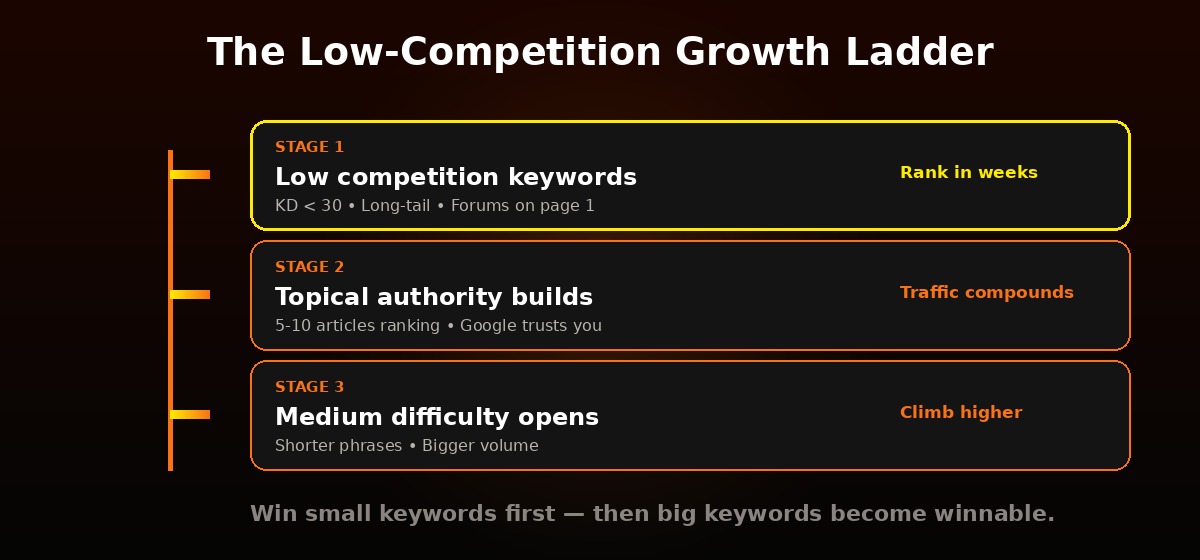
How do you spot low competition keywords? Look for these signals:
- Low KD score in your tool (under 30 is a common beginner threshold).
- Small or unknown sites ranking on page one instead of major brands.
- Forums and Reddit threads ranking — Google fills gaps with forums when no good content exists, which is an open invitation for you to write it.
- Missing information in top results: no recent dates, no step-by-step detail, weak titles you can clearly beat.
Stack five to ten ranking articles on low competition keywords and something powerful happens: your domain builds topical authority. Google starts trusting your site on that subject, and medium-difficulty keywords gradually open up. This is how most successful niche blogs grew — not by winning one huge keyword, but by collecting dozens of small ones. That patient approach is the heart of how to do keyword research for SEO.
How to Steal Keyword Ideas From Your Competitors
One of the fastest shortcuts in how to do keyword research for SEO is letting your competitors do the work. Every established site in your niche has already tested hundreds of keywords — and publicly revealed which ones bring them traffic.
Here is the competitor keyword research process:
- Identify 3–5 competitors in your niche that are slightly bigger than you, not the giants. Their keyword profile is achievable; a massive authority site's is not.
- Enter their domain into Ubersuggest's free tier or a Semrush free search to see their top pages and the keywords driving traffic.
- Filter for low KD versions of their keywords. If a small competitor ranks for "free portfolio websites for freelancers" with weak content, you can rank with something better.
- Find their content gaps. Look for keywords where they rank on page two or three — those are topics they have not covered properly, which is an open opportunity for you.
- Improve, never copy. Take the keyword and the intent, then write something noticeably more helpful: more detail, fresher examples, better formatting.
Competitor research turns keyword research from a creative guessing game into a data-driven process. Instead of asking "what should I write?", you ask "what is already proven to work, and where are the weak spots?"
Keyword Research for Different Types of Content
Not every keyword belongs in a blog post. Part of learning how to do keyword research for SEO is matching keywords to the right type of page. Use this simple mapping:
| Keyword Signal | Best Content Type | Example Keyword |
|---|---|---|
| Questions starting with "how", "what", "why" | Informational blog post or guide | how to do keyword research for seo |
| "Best", "top", "review" phrases | Comparison or listicle post | best free keyword research tools |
| "Buy", "price", "discount" phrases | Product or service page | seo services pricing |
| Brand + "vs" + brand | Comparison article | rank math vs yoast |
| Local + "near me" or city names | Local landing page | seo expert in lahore |
Matching keywords to content types this way keeps your site organized and prevents the most common structural SEO mistake: forcing every keyword into a blog post regardless of intent. Your homepage targets your core service keywords, category pages target topic keywords, and posts target informational phrases — that is the architecture Google rewards.
Common Keyword Research Mistakes to Avoid
Even experienced marketers fall into these traps when practicing how to do keyword research for SEO. Avoid them and your keyword research stays effective:
- Chasing volume over relevance. A million searches mean nothing if the intent does not match your content or you cannot rank.
- Ignoring search intent. Always study page one before writing. The format of your article should match what already ranks.
- Targeting the same keyword on multiple pages. One keyword, one page — otherwise your articles compete with each other.
- Skipping keyword difficulty checks. Guessing difficulty is how new blogs waste months on impossible keywords.
- Researching once and never again. Trends shift. The best bloggers refresh their keyword lists monthly using Search Console data.
- Overusing tools, underusing judgment. Tools estimate; page one tells the truth. Always verify with real search results.
How to Do Keyword Research for SEO: Final Checklist
Before you publish your next article, run through this summary of how to do keyword research for SEO:
- Start with 10–20 seed keywords from your niche and expand them with Google Autocomplete
- Collect volume data from free keyword research tools like Keyword Planner and Ubersuggest
- Filter for low competition keywords with KD under 30 and weak page-one results
- Verify search intent by reading what currently ranks before writing anything
- Prefer long-tail phrases — study real long tail keywords examples in your niche and copy the pattern
- Assign one keyword per page and cluster close variations as secondary keywords
- Refresh your research monthly using Google Search Console queries
Follow this version of how to do keyword research for SEO for your next ten articles and compare your traffic to the previous ten. The difference will make a believer out of you — keyword research is the closest thing SEO has to a guaranteed return on effort.
Frequently Asked Questions About Keyword Research
How do I do keyword research for SEO for free?
Learning how to do keyword research for SEO for free is simple: use Google Autocomplete for ideas, Google Keyword Planner for volume ranges, Ubersuggest's free daily searches for difficulty, and Google Search Console to find keywords you already rank for. That combination covers the full process at zero cost.
What are long tail keywords with examples?
Long-tail keywords are specific multi-word phrases with lower competition and clearer intent. Real long tail keywords examples include "best budget hotels in paris near eiffel tower" and "how to do keyword research for seo for free" — detailed phrases that convert better than generic ones.
How many keywords should a blog post target?
One primary keyword per post, supported by three to five closely related secondary phrases. Rank Math lets you set one focus keyword plus additional keywords, which keeps your optimization natural and covers variations without stuffing.
What is a good keyword difficulty for beginners?
Generally under 30, though the number varies by tool. More reliable signals are weak page-one results: forums, small sites, thin content or outdated articles. Those matter more than any single KD score.
How long does it take to learn how to do keyword research for SEO?
Once practiced, 20–40 minutes per article. Beginners may need an hour. The time is worth it — one hour of research saves weeks of writing content that never gets traffic.
Can I rank without keyword research?
Occasionally, through social shares or pure luck — but rankings rarely last. Sites that grow consistently treat how to do keyword research for SEO as step one of every article, not an optional extra.
Want a Keyword Strategy Built for Your Niche?
Keyword research is the foundation of every ranking article — but it takes time to do well. If you would rather skip the spreadsheets of how to do keyword research for SEO and get a done-for-you keyword and content plan, MeetWithZaman can research, map and outline the keywords your site can actually win.
Get In Touch Explore SEO Services